
How to build a betting bankroll, step by step
A step-by-step plan for building a betting bankroll: how much to start with, the rules to set, checkpoints from 100 to 1,000 picks and when to withdraw.
Most bankrolls are not built. They are deposited, bet until they are gone, and deposited again. Building one is slower and a lot less exciting: a fixed sum, a fixed stake, a record of every pick, and the patience to judge it over hundreds of picks rather than a weekend.
This is a step-by-step plan for doing that, from the day you set the money aside to the point where it starts to grow on its own. Our bankroll management guide explains the staking behind it, and compounding in betting explains the growth. This article puts it all in order.
The short version
- Set aside a sum you can afford to lose entirely, and keep it separate.
- Write your rules down before the first pick: 1% per pick, flat stakes, singles only.
- Record every pick, with the price you took and the closing price.
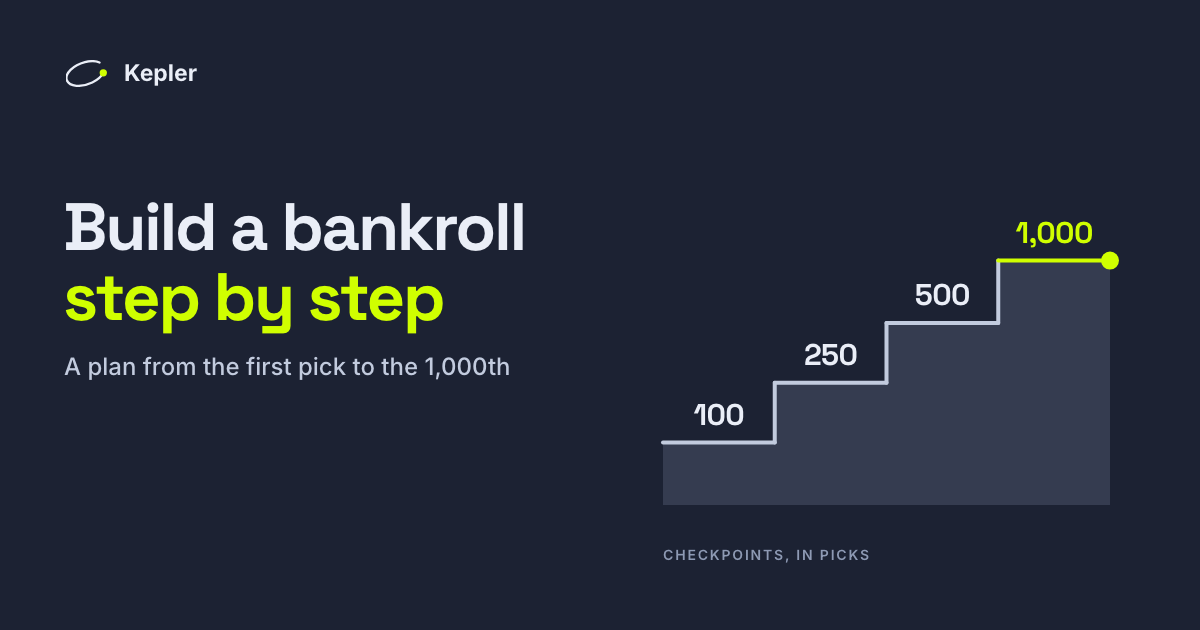
- Judge it at checkpoints of 100, 250, 500 and 1,000 picks, not by the week.
- Recalculate your unit once a month, up or down, from what is really there.
- Decide in advance what a normal losing run looks like, and what you will withdraw.
Step 1: Choose an amount you can afford to lose
A betting bankroll is money that can go to zero without changing anything else in your life: rent, bills, savings, nothing. If losing all of it would hurt this month, it is too much. It is never borrowed, and never money you expect to need.
It does not have to be large. At 1% per pick, a €500 bankroll means €5 stakes, and that is enough to learn everything this plan is meant to teach. What matters is that the amount is fixed. A bankroll you top up every time it falls is not a bankroll. It is a running cost.
Step 2: Keep it separate
Put the money in its own account or e-wallet, and fund your bookmaker accounts only from there. Winnings go back to the same place. Once betting money mixes with everyday money, you lose the one number this plan depends on: how much you have now compared with how much you started with.
Using several bookmakers to get the best prices is fine. Count them all as one bankroll, and add them up when you recalculate.
Step 3: Write your rules down before the first pick
Rules are easy to follow on a good day. You write them down for the bad ones. A plan built on how we stake our own record looks like this:
- Stake: one unit per pick, a unit being 1% of the bankroll. 2% at most.
- Flat: the same stake on every pick, whatever the odds and however sure it feels.
- Singles only. No accumulators: one miss sinks the whole ticket. See singles vs accumulators.
- Price: take a pick only at its "Bet at ≥" price or better. Below it, skip it.
- Unit review: on the first day of each month, and never in between.
- Losing runs: nothing changes until the drawdown passes the limit you set in step 7.
- Withdrawals: the rule you choose in step 8.
Why 1%? Even with a real edge, more than one history in ten falls over 20 units from its peak at some point in 500 picks. With units at 1%, that costs about a fifth of the bankroll. At 5% it costs all of it. The numbers are in the bankroll management guide.
Step 4: Record every pick from the first one
Write down the date, the match, the market, the price you took, the stake, the result and, once the match has started, the closing price. A spreadsheet is enough.
The closing price matters more than it looks. Profit takes hundreds of picks to mean anything, but whether your prices beat the closing price shows up much sooner. It is the earliest honest sign that the prices you take are good. More in why CLV is the only metric that matters.
If you follow our signals, the dashboard charts every published pick at one unit, and My Picks tracks the ones you record, in real money. The gap between the two is the part of the result that is yours: mostly the prices you got.
Step 5: Judge it at checkpoints, not by the week
Over short stretches, betting results are mostly noise. So set the points at which you will look properly, and draw no conclusions in between. Count the checkpoints in picks, not weeks. If you follow every pick we publish, that is several hundred a month (573 in September 2026), so the first 100 can come in a few days.
100 picks: too early to judge. Profit tells you almost nothing yet. Check one thing: that you get the prices, yours against the published ones. Don't change the stake, whichever way it went.
250 picks: a first reading. Closing line value starts to say something. Check that most of your picks beat the closing price. Don't judge on profit alone.
500 picks: a fair picture. A real edge is rarely still behind here. Look at profit and CLV together: if both are negative, stop and review. Don't raise the unit outside the monthly review.
1,000 picks: enough to trust the trend. Now decide whether to let the bankroll compound in full. Don't mistake a good run for a bigger edge.
To put numbers on it: picks with a genuine edge of about 6% are still behind after 100 picks about one time in four, and after 500 picks about one time in sixteen. Being behind at 100 picks tells you very little. Being behind at 500 with a negative CLV tells you a lot.
Step 6: Recalculate the unit once a month
On the first day of each month, add up the bankroll and set the unit to 1% of it. If the bankroll grew, the unit grows. If it shrank, the unit shrinks, and that is the plan protecting you, not failing.
Never recalculate in the middle of a run, in either direction. Raising the unit after a hot week means betting your biggest stakes just before the cold one. Topping the bankroll up after a bad week means you can no longer tell whether the plan is working.
That is all compounding is: the unit follows the bankroll, slowly. Over the first thousand picks it makes little difference. Over several thousand it makes most of it, as compounding in betting shows.
Step 7: Decide what a normal losing run is, before it happens
A losing run is not a sign the plan has failed. With a real edge, six or more losing picks in a row are routine, and a fall of 14 units from a peak is ordinary over 500 picks. Decide two things in advance:
- What changes in a normal drawdown: nothing. Same unit, same rules.
- When to stop and review: for example, when the bankroll is 30 units below its highest point, or behind at the 500-pick checkpoint with a negative CLV. Stop, go through the record, and check you are still getting the prices. Do not raise the stake to win it back.
Step 8: Decide your withdrawals in advance
Taking money out is the point of a bankroll, but every euro you withdraw stops compounding. Choose one rule and stick to it:
- Everything above the starting amount, at the end of each month. The bankroll stays the same size, but your winnings are never at risk.
- Half of each month's profit. A balance: some money out, some left to grow.
- Nothing for the first 1,000 picks, then one of the two above. Slowest to pay out, fastest to grow.
Whichever you choose, choose it now. A withdrawal decided on a good day tends to be too small, and one decided on a bad day tends to be everything.
A worked example: September 2026
Here is the plan applied to a real month: every pick we published in September 2026, one unit each at the published price, from a €1,000 bankroll with a €10 unit. The figures are our record as it stood on 16 October 2026; 11 losing days, 10 winning days goes through the month day by day.
- 3 September: down 8.42 units, or €84, after three red days in a row. This is the moment people without a plan double their stakes. The rules say nothing changes.
- 12 September: +13.05 units in one day, the best of the month. The rules say nothing changes here either.
- 13 September: −5.38 units, the worst day of the month, straight after the best.
- End of the month: +15.95 units, or €159.50. The bankroll stands at €1,159.50.
- 1 October: the unit becomes €11.60, 1% of the new bankroll.
Two cautions. September returned about 2.8% on what was staked, which is a good month, and one day made most of it. A month like that can just as easily end in the red, which is exactly what steps 5 and 7 are for. And these are the published prices: your own result depends on the prices you get.
Your bankroll plan on one page
Copy it, fill in the blanks, and keep it where you bet:
| Rule | My plan |
|---|---|
| Starting bankroll | €_____, money I can afford to lose |
| Unit | 1% = €_____, recalculated on the 1st of each month |
| Stake | 1 unit per pick, singles only |
| Price | Only at the "Bet at ≥" price or better |
| Record | Every pick, with my price and the closing price |
| Checkpoints | 100 / 250 / 500 / 1,000 picks |
| Review if | 30 units below the peak, or behind at 500 picks with a negative CLV |
| Withdrawals | _____ |
| Never | Top up after losses, raise the unit mid-month, chase losses |
Frequently asked questions
How much money do I need to start a betting bankroll?
Less than most people think. At 1% per pick, €500 means €5 stakes, which is enough to follow a plan properly. What matters is that it is money you can afford to lose entirely, and that you do not top it up when it falls.
How long does it take to build a betting bankroll?
Longer than most people expect. With a realistic edge of about 3% per pick and 1% stakes, a typical bankroll grows by around 30% over 1,000 picks and around 70% over 2,000, with falls along the way. Bigger stakes do not make it reliably faster: mostly they make the falls bigger.
Should I add money to my bankroll after losses?
No. If the bankroll falls, the unit falls with it at the next monthly review. Topping it up hides whether the plan is working, and turns a fixed risk into an open-ended one.
When should I increase my stake?
Only at the monthly review, and only because the bankroll grew: the unit stays at 1% of what is there. Never after a winning run, and never in the middle of a month.
What should I do during a losing run?
Nothing different, as long as it stays within the limit you set in advance. Six or more losses in a row are normal with a real edge. If the drawdown passes your limit, stop and review your record and your prices, but never raise the stake to win it back.
Betting involves risk. A plan decides how much you can lose and how fast, not whether you win. Past results do not guarantee future returns. Only bet what you can afford to lose. 18+.