
Compounding in betting: how a small edge becomes real money
What compounding really does to a betting bankroll: flat vs compounding stakes, why bigger stakes backfire, and lessons from The Psychology of Money.
A day that ends +2.23 units after ten picks can feel like nothing. It is not nothing: at typical odds it is a return of over 20% on what was staked that day, and no edge sustains that. But the feeling points at something real. A small edge only turns into meaningful money one way — slowly, by compounding — and compounding is the part of betting that people understand least.
This article looks at what compounding actually does to a betting bankroll, with numbers from 20,000 simulated histories rather than from a best-case spreadsheet.
The short version
- Compounding means staking a fixed share of your current bankroll, so your stakes grow as the bankroll grows — and shrink when it falls.
- Over the first thousand picks it makes almost no difference. Over several thousand it makes most of the difference.
- The return that matters is not the highest one, but the one you can keep earning for longest. Stakes that are too big end the story early.
- Compounding magnifies whatever edge you have — including a negative one.
What an ice age teaches about betting
In The Psychology of Money, Morgan Housel opens his chapter on compounding, "Confounding Compounding", with two observations.
The first is about Warren Buffett. Almost all of his fortune was made after his mid-sixties. He is a great investor, but what sets his wealth apart is that he started as a child and never stopped — the returns had seven decades to build on each other.
The second is about ice ages. According to the explanation Housel retells, they were not caused by brutal winters but by summers that were slightly too cool to melt the previous winter's snow. Each year a little remained, the extra snow reflected more sunlight, and the next summer was cooler still. A small, persistent difference, left to build on itself, covered continents.
The lesson for a bettor is the same. The question is not "how much can I win this month?" but "how long can I keep a real edge working?"
Flat staking against compounding
Take a realistic edge: picks that win about 57% of the time at odds of 1.80, a return on investment of +3%. Stake 1% of a bankroll on each pick.
- Flat: the stake is always 1% of the starting bankroll.
- Compounding: the stake is 1% of the current bankroll.
If every pick returned exactly its expected value, the two would grow like this:
| Picks | Flat staking | Compounding |
|---|---|---|
| 1,000 | ×1.30 | ×1.35 |
| 2,000 | ×1.60 | ×1.82 |
| 4,000 | ×2.20 | ×3.32 |
| 8,000 | ×3.40 | ×11.02 |
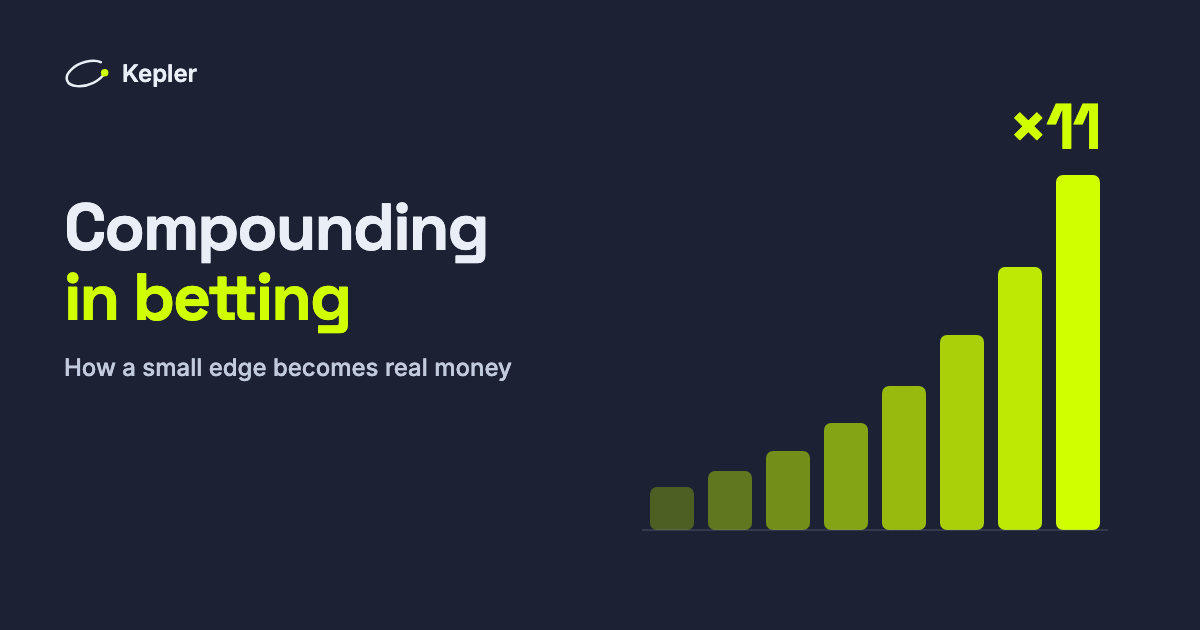
For the first thousand picks there is barely a gap. By eight thousand, compounding has turned a bankroll into eleven times itself while flat staking has not reached four. Nothing changed in the picks or the edge. Only time did.
Real bankrolls do not grow in a straight line
Expected values hide the ride. Here is the same +3% edge, compounding at 1% of the current bankroll, across 20,000 simulated histories:
| Picks | Typical result | Worst 1 in 10 | Chance of being below the start | Typical worst drawdown |
|---|---|---|---|---|
| 1,000 | ×1.29 | ×0.90 | 17% | 21% |
| 2,000 | ×1.70 | ×1.01 | 9% | 26% |
| 4,000 | ×2.84 | ×1.38 | 3% | 32% |
Two things stand out. Even with a genuine edge, about one bankroll in six is still below where it started after a thousand picks. And the typical history includes a fall of a fifth to a third from its highest point. Compounding works on the long run after surviving the short one.
Why bigger stakes are not a shortcut
It is tempting to stake more to get there faster. Here is what 2% and 5% of the current bankroll do with the same edge over 2,000 picks:
| Stake per pick | Typical result | Chance of losing half or more | Typical worst drawdown |
|---|---|---|---|
| 1% | ×1.70 | under 1% | 26% |
| 2% | ×2.46 | 2% | 47% |
| 5% | ×2.62 | 19% | 85% |
At 5%, the typical outcome is barely better than at 2% — but one bankroll in five loses half or more, and the typical history falls by 85% at some point along the way. Very few people keep following a method through that, and a method you abandon compounds nothing.
This is Housel's point in betting form: good returns you can sustain beat great returns you cannot. For most bettors that means 1% per pick, 2% at most — the same sizing our bankroll management guide arrives at from the other direction.
"Just raise your unit" — the right way
A common piece of advice is that if you want to earn more, you do not need a higher win rate, just a bigger unit. It is half true. A bigger unit multiplies the swings by exactly as much as it multiplies the profit; it does not change the edge.
Compounding raises the unit for you, and only when the bankroll has earned it. Starting from €1,000 at 1% per pick, the typical unit grows like this:
| After | Typical bankroll | Unit (1%) |
|---|---|---|
| Start | €1,000 | €10.00 |
| 1,000 picks | €1,292 | €12.92 |
| 2,000 picks | €1,669 | €16.69 |
| 4,000 picks | €2,838 | €28.38 |
How to compound in practice
- Recalculate the unit on a schedule — once a month, say — as 1% of the bankroll you actually have. Not after every bet, and never in the middle of a losing run.
- Let it go down as well as up. If the bankroll falls, the unit falls with it. That is what stops a bad run from becoming a ruinous one.
- Decide your withdrawals in advance. Every euro you take out stops compounding. That is fine — it is what the money is for — but choose a rule (a fixed amount, or everything above a target) instead of deciding on a good day.
- Bet singles. An accumulator multiplies the bookmaker's margin along with the odds; see singles vs accumulators.
What compounding cannot do
Compounding is a multiplier, not an edge. A bettor with a negative edge who compounds loses faster, in exactly the way a positive edge wins faster. Before worrying about growth, make sure the edge is real: judge it on hundreds of picks and on closing line value, which shows whether you beat the market long before profit does.
The figures above are simulations of an assumed +3% edge at odds of 1.80, with independent picks settled at the prices taken. They are not a forecast of any service's results, ours included. Our real, settled results — wins and losses alike — are on the track record.
Frequently asked questions
What does compounding mean in betting?
Staking a fixed share of your current bankroll rather than of your starting one, so stakes grow as the bankroll grows and shrink when it falls.
Does compounding make a big difference?
Not at first. At a +3% edge and 1% stakes it adds almost nothing over 1,000 picks, but after 8,000 picks it turns ×3.4 with flat stakes into roughly ×11.
Should I stake more to compound faster?
No. Above about 2% per pick the swings grow much faster than the typical return: at 5%, one bankroll in five loses half or more over 2,000 picks.
Betting involves risk. Past results do not guarantee future returns, and compounding increases losses as surely as it increases gains. Only bet what you can afford to lose. 18+.