
Closing line value: the only metric that matters
Win rate needs hundreds of settled bets to separate skill from luck. Closing line value reads every bet the day it is placed. Here is what good looks like.
If you back a coin flip at 2.10 and lose, you were right and unlucky. If you back it at 1.90 and win, you were wrong and lucky. A win rate cannot tell those apart, and it needs a very large number of settled bets before it starts to.
Closing line value can tell them apart on every single bet, before the match is even played.
What CLV actually measures
CLV compares the price you took against the price the market settled on immediately before kick-off:
CLV = (your price / closing price) − 1
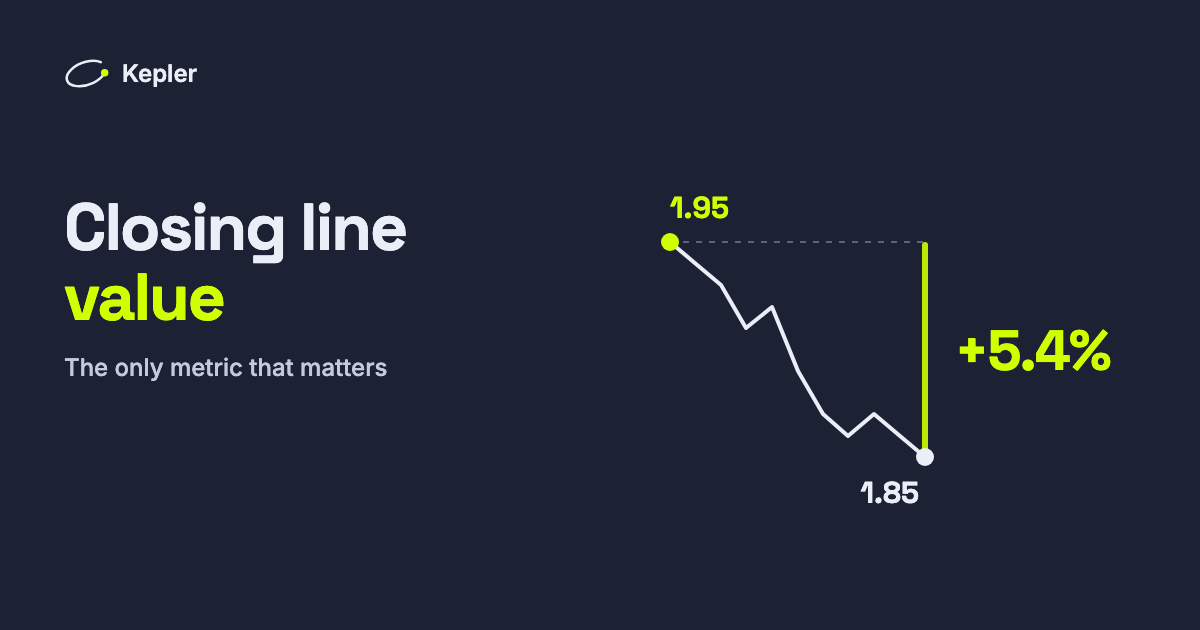
Take Over 2.5 at 1.95 on a match that closes at 1.85, and your CLV is +5.4%. You bought something that later became more expensive. The bet may still lose — one match is one match — but you were on the right side of where the market moved.
Why the closing price is the benchmark
A closing price is not one bookmaker's opinion. It is the number that survived every professional bettor pushing against it, in size, right up to kick-off. It is the most accurate probability estimate that exists for that match, and it is available for free.
That makes it a far better yardstick than the outcome. The outcome of a single match is almost entirely noise. The closing price is almost entirely signal.
The sample-size argument
This is the part that decides it. Suppose you are a genuinely good bettor with a 3% edge, betting at even money. How many bets before your win rate proves it?
| Settled bets | 95% interval on a 51.5% true rate |
|---|---|
| 100 | 41.8% – 61.1% |
| 500 | 47.1% – 55.9% |
| 2,000 | 49.3% – 53.7% |
| 10,000 | 50.5% – 52.5% |
At 100 bets your record is consistent with being a losing bettor. At 500 it still is. You need thousands of settled bets — a year or more of serious volume — before a win rate separates a 3% edge from nothing at all.
CLV needs none of that. Every bet produces a reading the moment the market closes, and those readings are far less noisy because they are measured against a number rather than against a coin flip.
Positive CLV, negative ROI
This combination looks like a contradiction and is actually the most useful diagnostic in betting.
- Positive CLV, negative ROI — you are finding value and losing money anyway. That is variance, or staking, or taking bad prices on good picks. All three are fixable.
- Negative CLV, positive ROI — you have been lucky. There is no edge underneath the profit, and it will revert.
- Negative CLV, negative ROI — no edge. More volume will not help.
Only the first of those is worth working on, and only CLV tells you which one you are in.
The trap: comparing the wrong prices
Raw CLV has a systematic bias that is easy to miss. A bookmaker's margin is not constant — it tightens as kick-off approaches and the market gets sharper.
Measured across 566 Pinnacle price pairs on our own book, margin fell from about 5.05% at 48 hours out to 3.78% inside the final hour. That tightening makes the closing price look more generous on both sides of the market, which drags every raw CLV reading down by roughly 1.2 points.
The proof that this is an artefact rather than a real effect: scoring both sides of every market gave a mean raw CLV of −1.46%. That is impossible as a statement about line movement. Over and under cannot both drift against you.
Remove the margin from both ends — de-vigging — and the same pairs averaged −0.27%, with a median of exactly zero. Which is what you would expect from a fair comparison.
So: de-vig before you measure, or your CLV will read about a point too low and you will conclude you have no edge when you might.
What a good number looks like
Sharp bettors treat consistent positive CLV as the goal, and the bar is lower than people expect:
- 0% to +1% — you are matching the market. Not an edge, but not being picked off either.
- +1% to +3% — a real, sustainable edge. This is where most professional syndicates operate.
- Above +5% — either exceptional, or you are measuring against a soft book and calling it sharp.
That last point matters. CLV only means anything against a genuinely sharp closing price. Measured against a recreational book's close, a large positive number mostly reflects that book's margin rather than your skill.
How we report it
Our track record shows CLV de-vigged, against Pinnacle's close where Pinnacle prices the market. Where it does not — Pinnacle posts no both-teams-to-score market anywhere — the reference is stated rather than quietly pooled, because a soft book's shape is biased as well as its margin, and averaging it in would let noise set the headline.
Rows where we could not obtain both sides are marked as raw rather than de-vigged, for the reason above: those read about a point low, and hiding that would be the same mistake dressed differently.