
Singles vs accumulators: why we recommend single bets
On a day with five signals, four winners is a good day with singles and a losing day with an accumulator. What accumulators do to your odds, your swings and your record.
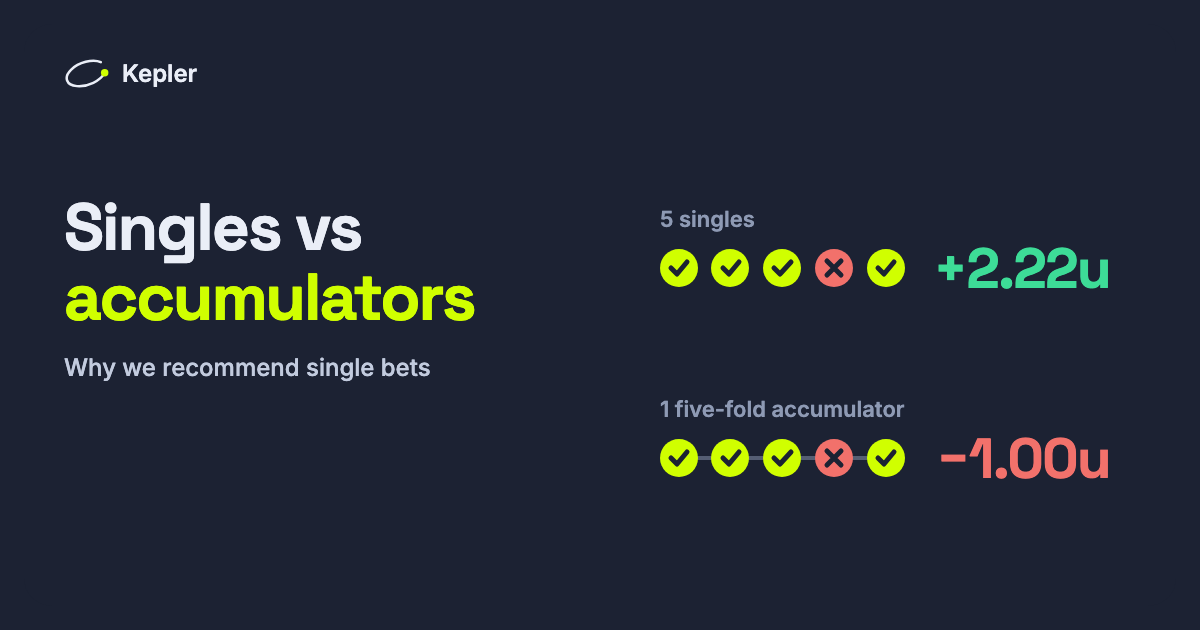
A typical day on Kepler produces a handful of signals. Say five. A good day is not five winners. A good day is three or four — and that is exactly what the model is built for: many single bets, each at a price that is better than it should be, adding up over weeks and months.
Put those same five picks into one accumulator, and a day with four winners becomes a losing day. This article explains why we recommend single bets, what an accumulator actually does to your numbers, and why our record and your accumulator are two different things.
The short version
- Bet each signal as a single, at a flat stake.
- An accumulator (a parlay) only pays if every leg wins. One miss loses the whole stake.
- Our track record is measured on singles. It says nothing about how an accumulator of the same picks would have done.
- The model does not guarantee wins. No model does. What it aims for is a small edge on each bet, and that edge only shows up over a large number of bets.
One miss sinks the whole ticket
At the time of writing, our published record wins about 59% of its picks at average odds of around 1.80 (the live figures are on the track record and move as picks settle). Take five picks like that on one day. Here is every possible outcome, staking 1 unit on each of five singles, or 1 unit on one 5-fold accumulator:
| Winners out of 5 | How often | Five singles | One 5-fold accumulator |
|---|---|---|---|
| 5 | 7.1% | +4.02u | +18.11u |
| 4 | 24.7% | +2.22u | −1.00u |
| 3 | 34.5% | +0.41u | −1.00u |
| 2 | 24.1% | −1.39u | −1.00u |
| 1 | 8.4% | −3.20u | −1.00u |
| 0 | 1.2% | −5.00u | −1.00u |
The two most likely days — three or four winners, together about 59% of all days — are profitable with singles and a total loss with the accumulator. With singles, roughly two days in three end in profit. The accumulator wins about one day in fourteen.
"But the accumulator pays 19 times the stake"
It does, and it is worth being honest about the maths, because this is where most of the confusion comes from.
If the edge on every leg were known exactly, and the matches had nothing to do with each other, an accumulator would multiply that edge along with the odds. On paper, five legs at +6% expected value each make an accumulator worth more than +30%. Two things break that in practice.
It multiplies the swings far more than the edge. A bet that wins one time in fourteen loses a lot, and often in a row. Even with the figures above:
| Losing accumulators in a row | Chance it happens |
|---|---|
| 10 | 48% |
| 20 | 23% |
| 30 | 11% |
That is close to an even chance of ten straight losses. It is not a bad month; it is how the bet is built. Most people change their stakes, chase losses or stop long before the average has time to appear — and a bankroll that runs out never reaches the long run.
It multiplies mistakes too. An edge is an estimate, not a fact. If the true win rate of those picks were 55% instead of 59%, a single at 1.80 would sit close to break-even (−0.8%), while the 5-fold accumulator would already be clearly negative (−3.8%). At 53%, singles lose 4.4% and the accumulator loses about 20%. A small error on each leg compounds into a large error on the ticket. Singles let a small edge do its work; accumulators turn a small uncertainty into a big one.
Our record is a record of singles
Every figure on our track record — profit, ROI, win rate, closing line value — is calculated as one flat unit on each published pick, bet as a single. That is what we measure, what we publish and what we stand behind.
An accumulator built from the same picks is a different bet with a different result. If you combine picks, your results will not follow the record, in either direction, and a handful of accumulator tickets cannot tell you whether the picks themselves were any good.
Why bookmakers love accumulators
Accumulators are among the most profitable products a bookmaker sells, and it is no accident that they come with boosts, insurance offers and big headline payouts. Every leg carries the bookmaker's margin, and those margins multiply along with the odds. For a bettor without a genuine edge on each leg, an accumulator is simply a more efficient way to lose.
How we recommend using the signals
- Singles only. One bet per signal.
- Flat stakes. The same stake on every signal, typically a small, fixed share of your betting bankroll. Our record uses one unit per pick.
- Judge over hundreds of bets, not days. Losing days are normal. So are losing weeks.
- Watch the prices, not just the scoreboard. Closing line value tells you whether you are getting good prices long before a win rate can — see why CLV is the only metric that matters.
Betting involves risk. Past results do not guarantee future returns, and no model — ours included — can promise that any bet, single or accumulator, will win. Only stake what you can afford to lose. 18+.