
AI sports betting: the algorithmic arms race
How AI changed sports betting on both sides of the market, what makes the best AI for sports betting, and how to judge sports betting AI tools.
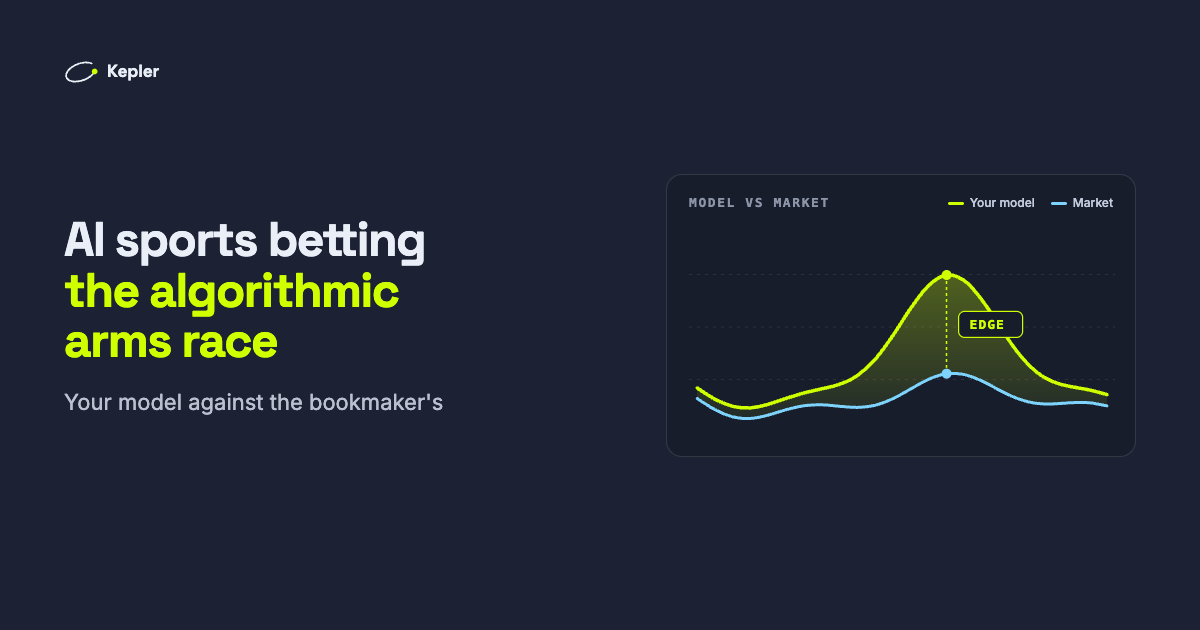
In 2026 you are not betting against a man with a clipboard. The price you see was set by a model, moved by other models and watched by a risk system that never sleeps. If your edge is a gut feeling and the league table, you are not the sharp side of that market. You are the money it runs on.
That is what AI sports betting has become: not a robot that "predicts games", but two sets of algorithms trading against each other, with everyone else in between. This article explains how both sides use AI, what separates the best AI for sports betting from a chatbot with a logo, and how to judge sports betting AI tools before you trust one with a stake.
Key takeaways
- Bookmakers run on AI now. Sharp books price and move lines with models fed by data and by the bets of the best customers; soft books copy those prices and profile their customers.
- The professionals do too. Syndicates build their own probability models and look for the moments a price is out of line - often at soft books that are slow to follow the sharp market.
- Basic stats are already in the price. Form, goals, even standard xG: if a free website shows it, the market has priced it.
- "AI" on a betting product proves nothing. What proves something is a public, complete record measured against the closing price.
How bookmakers use AI
There are two kinds of bookmaker, and they use AI for different things. The difference is explained in full in sharp vs soft bookmakers.
Sharp books such as Pinnacle make their money from volume at thin margins, and they welcome winning customers, because a winner's bet is information. Their pricing models take in match data, team news and market data, and their lines then move with the money: when respected accounts bet one side, the price adjusts within seconds. By kickoff, a sharp closing price is the best public estimate of a match there is.
Soft books make their money elsewhere: wider margins, promotions, casual customers. Many take their prices from the sharp market and shade them, and their AI goes into risk management - profiling accounts, spotting customers who consistently take good prices, and limiting them. If you win steadily at a soft book, it is often a model that notices first.
How syndicates use AI
On the other side sit the professional groups. They build their own probability models, often with a machine-learning layer on top of statistical ones, and compare the output with the market. When their number and the market's disagree by enough, they bet.
Much of that edge is found at soft books, in the gap between the sharp market moving and a soft book following it. The rest comes from modelling something the market underrates. Either way it takes infrastructure, discipline and accounts that have not been limited yet - which is why it has become a contest between algorithms rather than between opinions.
Why basic stats are not enough any more
A decade ago, a bettor with a spreadsheet of shots and goals could find prices that ignored them. Today that information is in every model on the other side of the bet. Standard expected goals is the clearest example: it is shown on television and on free apps, so it is in the price - see why xG alone is not enough.
An edge now has to come from combining information well, measuring the market properly and being disciplined about when not to bet.
What makes the best AI for sports betting?
Not a clever name, and not a win rate. Five things matter:
- It outputs probabilities, not tips. "Home win" is an opinion; "58%" is something you can compare with a price.
- It compares them with a fair price. A bookmaker's odds include its margin. Remove it first, or every edge looks smaller or bigger than it is - see de-vigging explained.
- It says no most of the time. A model that finds value in every match is not finding value.
- It is measured against the close. Closing line value shows whether the picks were taken at better prices than the market finally settled on - long before profit can tell skill from luck. See why CLV matters.
- Its record is public and complete. Every pick, winners and losers, at the price it was given.
How to judge sports betting AI tools
Before paying for any of them, run this checklist:
| Ask | Good sign | Red flag |
|---|---|---|
| Is there a full record? | Every pick, with price and result | Screenshots of winners |
| What is it measured on? | Return and closing line value | Win rate on its own |
| What does it promise? | An edge, with variance stated | "Guaranteed" or "sure" anything |
| How does it price? | Probability against a fair, margin-free price | "Our AI is confident" |
| How many picks? | A selective few each day | Value in every match |
A win rate without odds is meaningless: 70% at 1.30 loses money. And a "99% accurate AI" is not a product, it is a warning.
Where Kepler fits
Kepler is built on the principles above, and it is honest about what it is not.
Our model combines match statistics - our own expected-goals estimate, shots, corners, possession, form at home and away, rest days, league context - with a machine-learning layer, and produces a probability for each market. That probability is compared with the sharp market's price once its margin is removed, and a signal is published only when the gap is large enough. Signals go to your terminal.
What Kepler is not is a high-frequency trading desk. We do not race soft books for seconds-long gaps. We find matches where the model's price and the market's disagree, and we show you the evidence of whether that has worked. In September 2026 the public record was 573 picks at +2.4%, with an average closing line value of +1.94% and 57.8% of picks beating the close - all in the September report and the public track record. One month is a small sample, and we say so.
That is the honest answer to "what is the best AI for sports betting": the one whose record you can check, measured the way professionals measure themselves.
Frequently asked questions
What is the best AI for sports betting?
One that gives probabilities rather than tips, compares them with a margin-free sharp price, publishes only when the gap is large enough, and keeps a complete public record measured by closing line value. Be wary of anything sold on win rate alone.
Can AI beat the bookmakers?
Some models do find a small positive edge, best shown by consistently beating the closing price. Margins are thin, results swing a lot over short periods, and soft bookmakers limit winning accounts. No AI can guarantee a profit.
How do bookmakers use AI?
Sharp bookmakers use models to set prices and move them with the market and their best customers' bets. Soft bookmakers tend to copy sharp prices and use AI for risk management, including spotting and limiting customers who win.
How should I choose a sports betting AI tool?
Look for a full public record with the price of every pick, closing line value as well as profit, honest statements about variance, probabilities compared with a fair price, and few picks a day. Avoid guarantees and records made of screenshots.
Betting involves risk. Past performance does not guarantee future results. Only stake what you can afford to lose. 18+.