
Sharp vs soft bookmakers: how the smart money wins
Sharp vs soft bookmakers explained: why Pinnacle welcomes winners, why soft books limit them, how betting syndicates work and where AI really finds value.
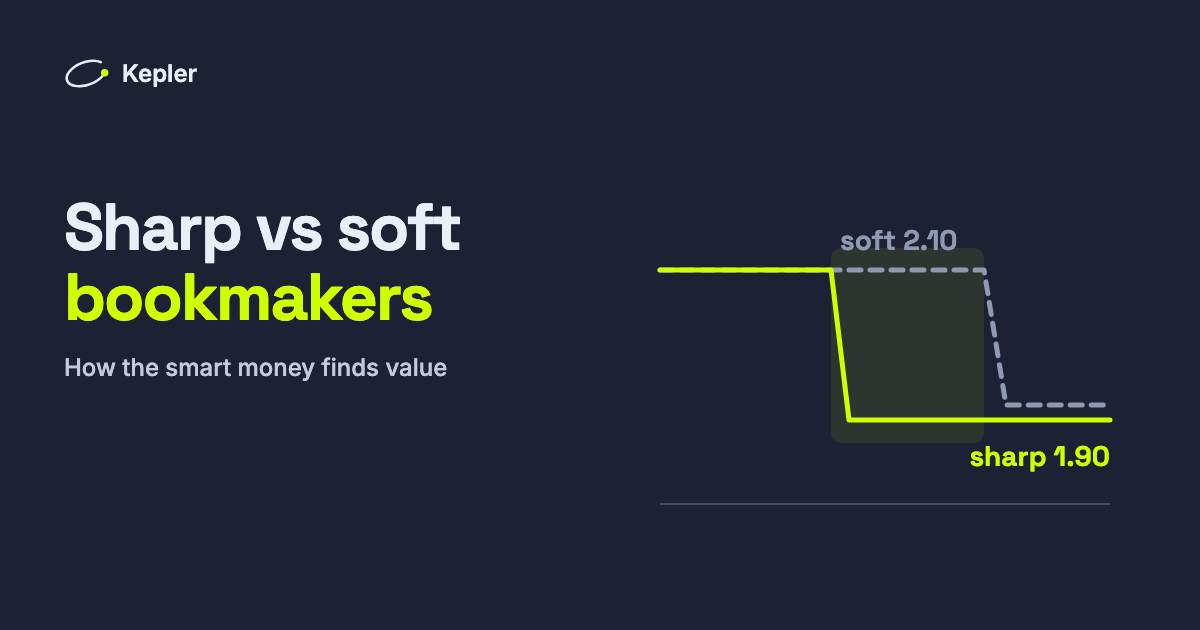
On a Saturday afternoon, millions of recreational bettors build five-leg accumulators. At the same time, a much smaller group of professional bettors does something far less exciting: they compare prices. They measure each bookmaker's odds against the sharpest price in the market, and bet only where a bookmaker has left a price too generous.
That difference — between betting on matches and betting on prices — is the whole story of sharp and soft bookmakers. This article explains how the two kinds of bookmaker work, why one welcomes winning bettors and the other restricts them, how betting syndicates really operate, and where AI genuinely fits in.
The short version
- Sharp bookmakers run low margins, take large bets and let winners keep betting — and use that money to make their prices more accurate.
- Soft bookmakers run higher margins, target recreational customers and protect themselves by limiting winners rather than sharpening their prices. UK data shows restricted accounts are almost twice as likely to be in profit.
- Value appears where a soft price is out of line with the sharp market: stale prices after news, lower leagues, generous promotions — and almost never in accumulators, where the bookmaker's edge compounds.
- Syndicates win on probability and execution, not on tips. Speed matters for some strategies, but the durable edge is pricing a match better than the market.
Sharp vs soft bookmakers: what is the difference?
A sharp bookmaker treats its odds as a market. It publishes a price with a thin margin, accepts large stakes, and moves its line when informed money arrives. Pinnacle is the best-known example and states the policy openly: under its Winners Welcome approach, it offers low margins and high limits and does not restrict customers for winning. The logic is simple: every sharp bet is information. A bookmaker that learns from winners ends up with the most accurate prices in the market — which is why the closing price at sharp books is the benchmark professionals use. The betting analyst Joseph Buchdahl has set out the maths behind the policy.
A soft bookmaker treats its odds as a product sold to recreational customers. Margins are higher, promotions are generous, and the trading team does not need to be the most accurate in the world — many soft books build their prices from data suppliers or from the sharp market, then adjust them. Instead of correcting a price when a skilled customer exploits it, a soft book can simply stop that customer from betting at size.
| Sharp bookmaker | Soft bookmaker | |
|---|---|---|
| Margin | Low | Higher |
| Limits | High | Varies; low for winners |
| Winning customers | Welcomed | Often restricted |
| Price discovery | Leads the market | Often follows it |
| Main customers | Professionals and informed bettors | Recreational bettors |
Why bookmakers limit winning accounts
In 2025 the UK Gambling Commission published the first large dataset on this practice. Its data request covered almost 15 million active betting accounts at some of the largest online operators, and the findings were striking:
- 643,779 accounts — 4.31% — were restricted in some form in 2024.
- The most common restriction was "stake factoring": cutting the maximum stake to a fraction of what other customers can bet. It applied to 62% of restricted accounts, and for 58% of those the cap was below 10% of the normal maximum.
- 46.8% of restricted customers were in profit, against 25.4% of all active customers.
The regulator's own conclusion is plain: bookmakers may act in their commercial interest, and being a successful bettor is not a protected characteristic. For bettors, the message is equally plain. At a soft book, winning is something you are eventually not allowed to keep doing at the same size.
Where soft bookmakers leave value
Soft bookmakers are not careless; they make mistakes in predictable places.
- Stale prices after news. When a confirmed line-up or significant money moves the sharp market, a soft price can lag behind for a while. For that window, it is out of line with the rest of the market.
- Lower leagues and niche markets. Soft books invest their trading attention where their customers bet. Second divisions and less popular markets get less of it, and their prices drift further from fair.
- Promotions and price boosts. A boosted price can be genuinely above fair value. The bookmaker accepts the loss as marketing — up to a limit.
- Not accumulators. Multiples are where soft books make the most money. If each leg returns 95% of its fair value, a five-leg accumulator returns 0.95⁵ ≈ 77% of its stake on average: the bookmaker's edge multiplies with every leg. See singles vs accumulators.
The common thread is the comparison. A price is only "value" relative to something more accurate — and the most accurate reference available is the sharp market's price with the margin removed. (For how to remove it, read de-vigging explained.)
How betting syndicates work
Professional syndicates are less mysterious than their reputation. Two of the best-known figures in football betting are Tony Bloom, owner of Brighton & Hove Albion and founder of the betting consultancy Starlizard, and Matthew Benham, owner of Brentford, a former employee of Bloom's who, as The Guardian reported, developed statistical models to make smart sports bets and owns the data firm Smartodds and the exchange Matchbook.
The method behind operations like these has three parts:
- A model that estimates the probability of each outcome more accurately than the market — built from data, not opinion.
- A comparison of that probability against every available price, betting only where a price is higher than fair value.
- Execution at size, which is why professionals favour sharp bookmakers, exchanges and Asian markets with high limits — the venues that do not restrict them.
What separates a syndicate from a tipster is the second step. A syndicate does not ask "who will win?" — it asks "is this price wrong, and by how much?"
Where AI really fits — and where it does not
"AI" in betting covers two very different things.
Speed. Automated software can scan hundreds of bookmakers every few seconds and flag the moment a soft price falls out of line with the sharp market. This is real, and it works — briefly. It is a race won by bots placing bets in seconds, and it is exactly the activity that soft books detect and restrict first. A person reading a signal and placing a bet by hand will not win a latency race.
Probability. The other use of AI is to estimate the true chance of an outcome better than the market does: combining many variables, weighing recent information correctly and calibrating the result. This edge does not depend on being faster than a bookmaker's update — it depends on being more right than the price. It is slower, quieter and far more durable.
Where Kepler fits
Kepler is built for the second kind of edge, not the first. It is not a betting bot, and it does not try to beat soft bookmakers' updates by milliseconds.
Its model produces a calibrated probability for each market, and every pick is measured against the sharp market's price with the margin removed — the same yardstick professionals use. Each signal shows that reference price and the pick's fair odds, so you can judge any bookmaker's price in seconds: above the fair odds, the edge is still there; below them, it is gone. Picks are published before kick-off and judged by whether they beat the closing price, on a public track record that lists every result.
In short: the sharp market tells us what fair is; the model tells us when the market is wrong; the fair odds tell you which bookmaker's price is still worth taking.
How to bet like the smart money
- Bet prices, not teams. Ask whether a price is higher than fair value, not who you think will win.
- Use the sharp price as your reference. Remove the margin and compare. A soft price above that line is a candidate; one below it is a donation.
- Shop for the best price. The same pick at 2.05 instead of 1.95 is a 5% better return on every winning bet.
- Prefer singles, stake flat. Accumulators multiply the bookmaker's edge; a disciplined bankroll plan protects yours.
- Measure closing line value. It tells you whether you are beating the market long before profit does.
- Stay within the rules. Opening accounts in other people's names to avoid limits breaks bookmakers' terms and can lose you your balance.
Frequently asked questions
What is the difference between sharp and soft bookmakers?
Sharp bookmakers run low margins, take large bets and do not limit winners, so their prices are the most accurate in the market. Soft bookmakers run higher margins for recreational customers and restrict accounts that win.
Why do bookmakers limit winning accounts?
Because a soft bookmaker earns its margin from recreational bettors and loses to informed ones. UK Gambling Commission data for 2024 showed 46.8% of restricted customers were in profit, against 25.4% of all active customers.
How do betting syndicates work?
They model each outcome's probability, compare it with every available price, and bet only where a price is above fair value, at high-limit bookmakers, exchanges and Asian markets that do not restrict them.
Betting involves risk. Past results do not guarantee future returns. Only bet what you can afford to lose. 18+.