
What is a value bet? A simple guide with examples
A value bet is a pick whose odds pay more than its real chance deserves. Learn to spot one with a coin, a football match and one simple formula.
Most people choose a pick by asking one question: who is going to win? Value betting asks a different one: are the odds too generous?
A value bet is a pick where the odds pay more than the real chance of it happening deserves. That is the whole idea. This guide explains it with a coin, a football match and no difficult maths.
In short
- Odds are a price for a chance. Odds of 2.00 mean a 50% chance.
- A pick has value when its odds are higher than its fair odds.
- Value is not the same as "likely to win". A favourite can have no value, and an outsider can have plenty.
- Value picks still lose, often. The edge shows over hundreds of picks, not in one match.
Start with a coin
A fair coin lands heads half the time. Say a friend offers you odds on heads, and you stake €10 on it, 100 times in a row.
- At odds of 2.00, each win pays back €20: your €10 plus €10. You win about 50 times and get back €1,000 for the €1,000 you staked. You break even.
- At 1.80, each win pays back €18. Fifty wins bring back €900. You lose €100.
- At 2.20, each win pays back €22. Fifty wins bring back €1,100. You make €100.
The coin is the same every time. Only the price changes. The 2.20 is a value bet: you still lose half of the flips, but the price pays you more than the risk is worth.
Odds are a price for a chance
Every decimal price hides a chance. To find it, divide 1 by the odds:
| Odds | The chance it implies |
|---|---|
| 1.50 | 1 ÷ 1.50 = 67% |
| 2.00 | 1 ÷ 2.00 = 50% |
| 2.50 | 1 ÷ 2.50 = 40% |
| 4.00 | 1 ÷ 4.00 = 25% |
It works the other way round too. If something has a 50% chance, its fair odds are 1 ÷ 0.50 = 2.00. Fair odds are the price at which you would neither win nor lose in the long run.
Real bookmaker prices also hide a margin, which is how the bookmaker gets paid. Taking it out is a step of its own, explained in de-vigging: recovering the true probability.
The value test, in one line
Value = chance × odds − 1
If the answer is above zero, the pick has value. For the coin at 2.20:
0.50 × 2.20 − 1 = +0.10 → +10%
That +10% is called the edge: on average, every €10 staked comes back as €11. At 1.80 the same sum gives 0.50 × 1.80 − 1 = −10%, and every €10 comes back as €9.
A football example
Now a match. Say a model gives Over 2.5 goals in Saturday's match a 58% chance.
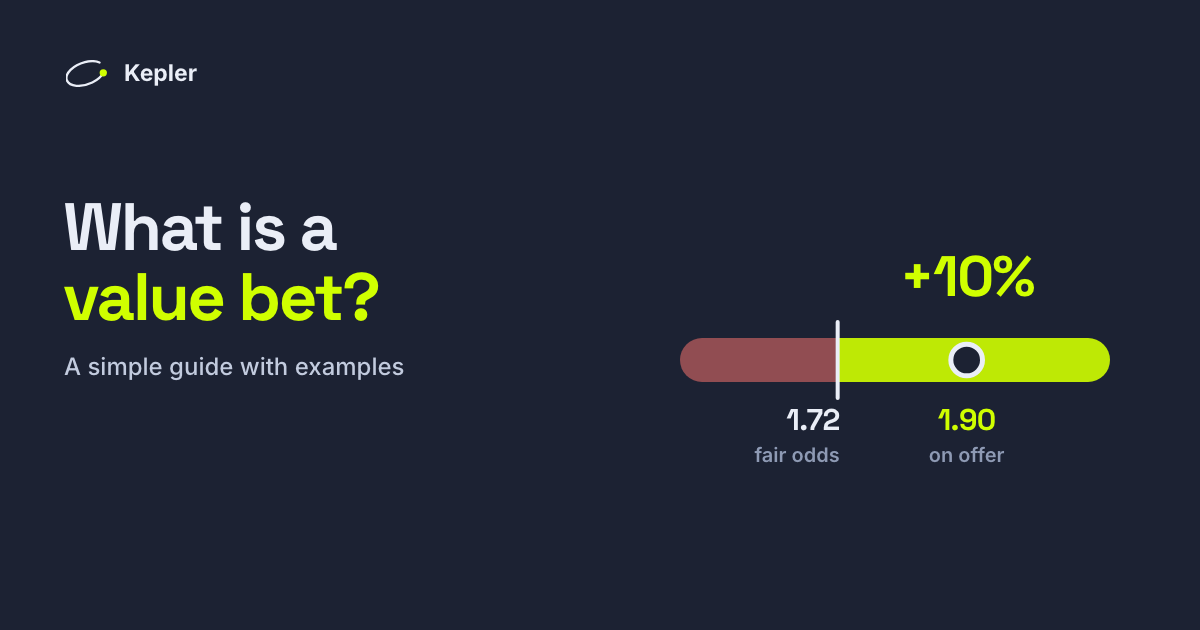
Its fair odds are 1 ÷ 0.58 = 1.72. Any price above 1.72 is value. Any price below it is not.
Two bookmakers offer the same pick:
| Odds | Value test | |
|---|---|---|
| Bookmaker A | 1.65 | 0.58 × 1.65 − 1 = −4.3% |
| Bookmaker B | 1.90 | 0.58 × 1.90 − 1 = +10.2% |
Same match, same goals, same chance. At bookmaker A it is a bad price. At bookmaker B it is a value bet. That is why the price you take matters as much as the pick itself.
Likely is not the same as value
Value bets are often mixed up with "safe" picks. They are different things.
Take a big favourite with a 75% chance of winning, at odds of 1.25: 0.75 × 1.25 − 1 = −6%. It will probably win, but the price is too low. Over many picks like it, you lose money.
Now take the draw in a match where it has a 30% chance, at odds of 3.60: 0.30 × 3.60 − 1 = +8%. It loses seven times out of ten, and it is still the better pick, because the price more than pays for the risk.
Value picks still lose, a lot
A pick with a 58% chance loses 42% of the time. That is not the model failing; it is what 58% means. Four or five losses in a row are normal, even with a real edge.
Here is one possible run of 20 picks, each with a 58% chance at odds of 1.90, staking one unit on each:
Judge value over hundreds of picks, never over a weekend. Staking the same small amount every time keeps a bad week small: see our bankroll guide.
The hard part: knowing the real chance
The maths above is easy. The hard part is the 58%. If your idea of the chance is wrong, the value you see is not real.
There are two good ways to get the chance:
- A model. Statistical and machine learning models estimate the chance of each outcome from data such as past results, goals and the strength of each team. That is what Kepler does for every match it covers.
- The sharp market. A few bookmakers, known as sharp bookmakers, set very accurate prices. Their price, with the margin taken out, is a good estimate of the real chance. When a soft bookmaker pays more than that, it is often value. See sharp vs soft bookmakers.
And there is one good way to check yourself: closing line value. If the odds you took are usually higher than the final odds at kick-off, you are finding value. See why CLV is the only metric that matters.
How Kepler shows value
Every signal in the Kepler terminal is built on this test:
- Bet at ≥ is the fair odds, the lowest price still worth taking. Above it, the pick has value.
- Best now is the best price on offer right now, and which bookmaker has it.
- Edge is the value test as a percentage: green above zero, red below.
- If the price falls below the fair odds, the signal is marked No value. It stays in the terminal, so nothing quietly disappears.
Every pick is recorded on the public track record, wins and losses alike.
A quick checklist
- Find the chance first, then look at the odds.
- Work out the fair odds: 1 ÷ chance.
- Only take prices above the fair odds.
- Compare bookmakers: a better price is a bigger edge on the same pick.
- Stake the same small amount every time, and judge over hundreds of picks.
Frequently asked questions
What is a value bet in simple terms?
A pick where the odds pay more than the real chance of it happening deserves. A coin flip has a 50% chance, so its fair odds are 2.00: taking heads at 2.20 is a value bet, and taking it at 1.80 is not.
How do you calculate a value bet?
Multiply the chance by the decimal odds and subtract 1. Above zero is value: a 58% chance at odds of 1.90 gives 0.58 × 1.90 − 1 = +10.2%. The fair odds are 1 divided by the chance, here 1.72.
Does a value bet always win?
No. A pick with a 58% chance still loses 42% of the time, and losing runs are normal. Value shows over hundreds of picks, which is why flat stakes and patience matter.
Is a value bet the same as a sure bet?
No. A sure bet, or arbitrage, backs every outcome at different bookmakers to lock in a small profit. A value bet backs one outcome at a price that is too high, and it can lose.
Betting involves risk. Finding value is how an edge is built, but it does not guarantee a profit, and no model can promise that any pick will win. Only stake what you can afford to lose. 18+.