
Weather in football betting: rain, wind and cold
We checked 6,108 matches: rain doesn't mean fewer goals. How weather changes football, how long weather delays last, and what it means for your bets.
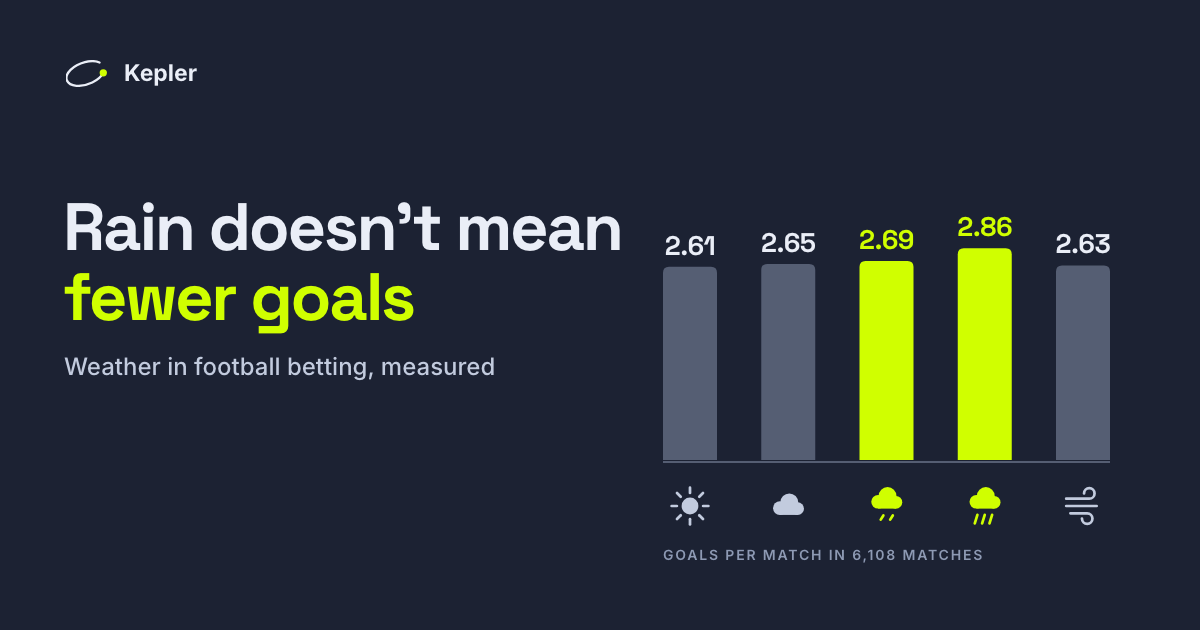
Every winter someone says it: the rain is coming, so back the unders. Or the wind will turn it into a lottery, so take the draw. Weather is the easiest story in football betting to tell, and one of the hardest to make money from.
It does change matches, but less than the stories suggest. We checked 6,108 English league matches against the weather they were played in, and rain did not lower the number of goals. This article covers what weather actually does to a game, what the numbers say, how weather delays work, how players cope with the cold, and what it all means for your bets.
The short version
- Weather matters most at the extremes. A grey, drizzly evening changes very little. Strong wind, a waterlogged pitch, snow or serious heat can.
- Rain does not mean fewer goals. Matches played in rain averaged slightly more goals than dry ones, not fewer. A wet pitch speeds the ball up and causes mistakes. Only standing water slows a match down.
- Both teams play in it. Bad weather hurts the side that relies on passing more than the side that doesn't, but it rarely turns a strong team into a weak one.
- The closing price was right on average. It expected over 2.5 goals in 49.7% of the matches, and 49.7% went over. It did not treat rain as a reason for unders either.
- The biggest risk is the match not being played. Postponed and abandoned matches follow your bookmaker's rules, and those rules differ.
What weather really does to a football match
Wind is the condition most likely to change how a match is played. Long balls hang or run away, crosses drift, goal kicks fall short and set pieces become hard to judge. Teams that play short, patient football can keep the ball on the floor and suffer less. Teams that go long suffer more. What it does to the number of goals is less clear: wind causes mistakes, which can mean goals, but it also makes it harder to build good chances.
Rain works in two different ways, and they get mixed up. A wet surface makes the ball skid and speed up. Passes arrive faster, shots bounce awkwardly in front of goalkeepers, and defenders mistime challenges. Standing water does the opposite: the ball stops dead in puddles, passing becomes guesswork and the game turns scrappy. "It's raining" says very little on its own. It matters whether the pitch drains.
Heat slows a match down. Players press less and cover less ground, and the drop shows most in the second half. Competitions can add drinks or cooling breaks in hot conditions, and the time is added on at the end. In the leagues we cover, this matters most in Brazil, where a summer afternoon kick-off in high humidity is a different sport from an evening game in the south.
Cold on its own changes surprisingly little. Players adapt, and at professional level the pitch is the bigger issue: a frozen surface is hard, uneven and unsafe, and that is when matches get called off.
Snow affects visibility and stops the ball rolling true. Leagues switch to a brightly coloured ball when snow is on the ground, and heavy snow usually means a postponement rather than a strange game.
How weather changes the number of goals
This is the question most bettors care about, so we measured it. We took every match in the top four English divisions, from the Premier League down to League Two, over three seasons (2022/23 to 2024/25): 6,108 matches. For each one we looked up the weather at the home ground, hour by hour, for the two hours the match was played, and set it against the result and the closing odds.
One adjustment keeps the comparison fair. More rain falls in winter, and a division can score differently in December than in August for reasons that have nothing to do with the sky. So each match is also measured against what the same division normally produces in the same month. That is the last column below.
| Weather during the match | Matches | Goals per match | Over 2.5 | Goals vs normal |
|---|---|---|---|---|
| All matches | 6,108 | 2.65 | 49.7% | |
| No rain | 3,400 | 2.62 | 48.6% | −0.04 (±0.05) |
| Light rain, under 2 mm | 1,525 | 2.69 | 51.3% | +0.05 (±0.08) |
| Rain, 2 mm or more | 152 | 2.86 | 59.2% | +0.19 (±0.27) |
| Snow | 75 | 2.47 | 41.3% | −0.12 (±0.40) |
| Sunny, daytime | 495 | 2.61 | 48.5% | −0.07 (±0.14) |
| Overcast, dry | 1,645 | 2.65 | 49.1% | −0.01 (±0.08) |
| Below 3°C | 323 | 2.65 | 50.8% | +0.05 (±0.18) |
| 20°C or warmer | 440 | 2.70 | 50.9% | +0.05 (±0.15) |
| Wind of 25 km/h or more | 915 | 2.63 | 50.9% | −0.02 (±0.10) |
| Gusts of 60 km/h or more | 338 | 2.68 | 52.1% | −0.01 (±0.18) |
The figure in brackets is the margin of chance: a difference smaller than it could easily be luck. It is wide where the group is small.
What the table shows:
- Rain did not reduce goals. Matches in light rain averaged slightly more goals than dry ones, and matches in steady rain more again. Neither gap is large enough to rule out chance, but the direction is the opposite of the folklore.
- Nothing else moved the total. Sun, cloud, cold, warmth and wind all finished within a few hundredths of a goal of normal.
- Snow is the one group below normal, and it is too small to mean anything. 75 matches, with a margin of 0.40 goals either way.
- Really heavy rain is rare. Only 26 matches had 5 mm or more during play, too few to measure on their own. Most matches that wet are postponed or abandoned, so they never make it into data like this.
Did the market know?
The same matches, priced at Pinnacle's closing odds with the margin taken out. The closing price expected over 2.5 goals in 49.7% of them, and that is how many did. The price also barely moved for the weather: it gave overs a 49.6% chance in the dry and 50.3% in steady rain. The market does not believe that rain means unders either.
There is one gap worth mentioning. In steady rain, 59.2% of matches went over 2.5, against the 50.3% the closing price expected. That looks like an edge, and it might be one. But it rests on 152 matches, the gap only just clears the margin of chance, and we checked around twenty weather groups. One of them crossing that line by luck alone is roughly what you would expect. Light rain, with ten times as many matches, showed a gap of just 1.4 points. We would want several more seasons before acting on it. What it is not, in any reading, is a case for unders.
A few honest limits. The weather comes from the Open-Meteo historical archive for the grid square around each ground, about 25 km across, not from a gauge at the stadium. It tells us how much rain fell, not whether the pitch drained. And this is England: few matches there are played in real heat, so the 20°C group says little about an afternoon kick-off in Brazil. The results and closing odds come from football-data.co.uk.
Why rain doesn't kill the goals
Light rain on a good pitch: no fewer goals. A wet, well-drained surface speeds the ball up. Shots skid off the turf in front of goalkeepers, crosses come in faster, and defenders slip or mistime tackles. Mistakes lead to goals as easily as they stop them. This is the rain most matches are played in, and in our data it came with 2.69 goals a match against 2.62 in the dry.
Heavy rain and standing water: chaos, not a clean under. Once water sits on the pitch, the ball stops in puddles and passing moves break down. Matches like this turn into long balls and second balls. Fewer good chances get created, but the ones that do come are often odd: a ball held up by water in front of a defender, a back pass that never arrives. The total can go down, but matches that wet are rare, and many are called off before they finish.
Sunny and mild: the baseline. Dry, mild conditions are what most matches are played in, and what most expectations are built on. If anything changes the goal count on a fine afternoon, it is the teams, not the sky.
Hot and sunny: a slower second half. In real heat, teams press less and cover less ground, and that shows most after half-time. Fewer sprints and less pressing can mean fewer chances, but tired defenders also leave more space late on. Heat is the condition where the timing of goals can shift more than the total.
Strong wind: more randomness, not fewer goals. Wind adds errors: misjudged long balls, crosses that drift, goal kicks that come straight back. It makes set pieces and shots from distance less predictable. Whether that adds goals or removes them depends on how the teams play, and in our data windy matches finished almost exactly at normal.
Cold and dry: almost no effect. Players adjust, and a cold night on a playable pitch looks much like any other match. Below 3°C, our matches averaged 2.65 goals, the same as the overall figure. The risk with cold is a frozen pitch and a postponement, not fewer goals.
Snow: rare, and unpredictable. When enough snow falls to matter, the ball stops rolling true and visibility drops. Most matches in real snow are postponed. The ones that go ahead are too few and too different from each other to say much about goals.
Two things matter more than any of this. Both teams play in the same weather, so a side that relies on passing loses more than one that goes long. And the market does not price rain as unders, so betting the under because it is raining is betting against a price that, on average, was right.
How long is a weather delay in football?
In football (soccer) there is no fixed length. The Laws of the Game leave it to the referee to decide whether the pitch and the weather allow a match to start or to continue, and the referee can stop it, suspend it or abandon it.
In practice:
- Lightning is the clearest case. The standard safety guidance, used by most competitions that deal with thunderstorms, is to clear the pitch and wait at least 30 minutes after the last thunder. Every new strike resets the clock, so a delay can run from half an hour to well over an hour.
- A waterlogged pitch usually means the players come off while ground staff try to clear the water, and the referee inspects again. If it does not improve, the match is abandoned.
- Before kick-off, a pitch inspection decides whether the match goes ahead at all. For frost or snow, that inspection is often held on the morning of the game, sometimes the day before.
If a match is abandoned, the Laws say it is replayed unless the competition rules decide otherwise. Some competitions start again from scratch. Others resume from the minute play stopped, with the score as it stood.
In American football the logic is the same for lightning: play stops when it is close by and resumes 30 minutes after the last strike, with every new strike restarting the wait. College football requires a minimum 30-minute delay. Cold on its own never postpones an NFL game.
How do football players stay warm in cold weather?
Mostly with layers you barely see.
- Base layers. Thermal undershirts and tights under the kit. The rules only ask that they match: undershirts the colour of the sleeves, undershorts and tights the colour of the shorts.
- Gloves. Any player may wear them, not just the goalkeeper.
- No snoods. Neck warmers were popular for a few seasons until the game's lawmakers banned them in 2011 as a safety risk.
- A longer warm-up, kept going until the last moment. Cold muscles are more prone to strains, so players try not to stand still before kick-off.
- Heated benches and dugouts for substitutes, and a sharp warm-up before coming on, because a player who has sat in the cold for an hour is not ready to sprint.
- Dry kit at half-time. A wet base layer drains heat fast, so players often change into dry ones for the second half.
How do football players play in freezing weather?
The players can usually cope. It is the pitch that decides.
The Premier League requires every club to have undersoil heating, which keeps the surface soft enough to play on through a freezing night. In the English Football League below it, clubs can use undersoil heating or full pitch covers, which is why frozen-pitch postponements are more common lower down. Some leagues avoid the problem entirely: in Sweden and Norway the season runs from spring to late autumn, around the worst of the winter.
When a frozen match does go ahead, it tends to look cautious. Players are wary of turning sharply on a hard surface, studs grip less, and the ball bounces higher and faster than they expect. Long passes that skid off a frosty pitch are hard to control, for attackers and defenders alike.
What it means for betting
The market has already had its say. In our data the closing price got the over 2.5 rate right on average, and it did not treat rain as a reason for unders. Whatever the weather really does to a match, the price at kick-off reflects it about as well as anyone can. This is the same reason we measure our picks against the closing price: by kick-off, everything known, the weather included, is in it. More in why CLV is the only metric that matters.
Forecasts get better close to the game. A forecast two days out is a rough guess, especially for wind and thunderstorms. If you think the weather matters for a match, check it again close to kick-off, and check whether the price has already moved.
Don't let one factor outweigh everything else. The quality of the two teams decides far more matches than the weather does. A storyline like "rain means unders" is easy to remember and easy to overrate, because the matches that fit it stick in the mind and the ones that don't are forgotten. Over 6,108 matches, it did not hold.
Know what happens if the match isn't played. If a match is postponed, most bookmakers void bets unless it is played within a set window, commonly a day or two, sometimes longer. If it is abandoned, bets on markets that were not yet decided are usually void, while markets already decided may stand. Both teams having scored before the abandonment is the classic case. Rules differ from bookmaker to bookmaker, so read them before betting on a match under a storm warning.
How we handle it. Our model does not use weather data. It prices a match from the two teams, and we compare that price with the market's, which reflects what the market knows, the weather included. Every signal then shows a "Bet at ≥" price, the lowest that still has value, and we check it every hour. If the price moves below it, because of a forecast or anything else, the signal is paused and shown as having no value at today's price. If you want to go further into prices, our guide to what a value bet is is the place to start.
Frequently asked questions
How long is a weather delay in football?
There is no fixed length: the referee decides. For lightning, the standard is to wait at least 30 minutes after the last thunder, and every new strike restarts the clock. A waterlogged pitch is inspected again once the ground staff have cleared what they can, and the match is abandoned if it does not improve.
How do football players stay warm in cold weather?
With thermal undershirts and tights in the kit's colours, gloves, a longer warm-up kept going until kick-off, heated benches for substitutes, and often a dry base layer at half-time. Snoods have been banned since 2011.
How do football players play in freezing weather?
The pitch decides, not the players. Premier League clubs must have undersoil heating, and lower-league clubs use heating or pitch covers. If the surface is frozen the match is postponed. When it does go ahead, play tends to be cautious and the ball bounces higher and faster.
Should I bet unders when it rains?
Not on rain alone. In 6,108 English league matches, those played in rain averaged slightly more goals than dry ones, 2.71 against 2.62, and the closing odds did not treat rain as a reason for unders. A waterlogged pitch is different, but those matches are often called off.
What happens to my bet if a match is postponed for weather?
Most bookmakers void it unless the match is played within a set window, commonly a day or two. If a match is abandoned, markets not yet decided are usually void, while those already decided may stand. Rules differ, so check your bookmaker's.
Betting involves risk. Weather can change a match in ways no model or forecast can predict. Only stake what you can afford to lose. 18+.